Salzburg Festival
Machine translation from Serbian, not reviewed. Original in Serbian
The festival will open on July 27 with Hugo von Hofmannsthal’s play “Everyman” (which has been in the festival’s repertoire since its founding), but that is not the only treat on the official program. “Ouverture Spirituelle” is the title of a new festival series devoted to sacred music. It began with Joseph Haydn’s oratorio “The Creation,” performed in English by tenor James Gilchrist, soprano Lucy Crowe, and soloists of the English Baroque Soloists under the baton of Sir John Eliot Gardiner. During the weeklong “Ouverture Spirituelle,” major classical musicians will take turns on the stages of Salzburg’s concert halls: baritone Thomas Hampson, conductors Claudio Abbado, Zubin Mehta, and Nikolaus Harnoncourt, and pianists Daniel Barenboim and Rudolf Buchbinder...
The opera season opened with Mozart’s “The Magic Flute,” directed by Jens-Daniel Herzog. One of the most popular operas of all time, it was performed by the Viennese instrumental ensemble “Concentus Musicus” on original instruments from Mozart’s era, with Nikolaus Harnoncourt conducting. The so-called second part of “The Magic Flute,” the opera “The Labyrinth” (or The Struggle with the Elements) by German composer Peter von Winter (1754–1825), has a libretto by Emanuel Schikaneder, whose vision of Sarastro’s future puts morality, steadfastness, and fidelity to the test. With all seven performances sold out, it could turn out to be one of the festival’s most pleasant surprises.
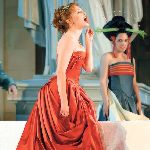
Advance sales had already filled the festival’s coffers with tried-and-true opera hits: “Carmen” (with Anna Netrebko as Mimì), “Ariadne on Naxos,” “La Bohème,” and Handel’s “Tamerlano” (with Plácido Domingo). Despite the very poor reviews it received after its premiere at the Spring Festival Weeks, George Frideric Handel’s “Julius Caesar,” featuring opera stars Andreas Scholl, Cecilia Bartoli, and Anne Sofie von Otter, is also a commercial hit at the festival, as is one of Mozart’s less frequently performed operas, “Il re pastore”— largely thanks to the celebrated Mexican tenor Rolando Villazón in the role of Alessandro.
One intriguing premiere is a new production of Bernd Alois Zimmermann’s (1918–1970) opera “The Soldiers,” based on the 1776 dramatic comedy of the same name by Jakob Michael Reinhold Lenz, a Lithuanian writer whom Goethe called a great humanist capable of “unmasking” the human ego. Zimmermann refused to see Lenz’s play as a comedy, drawing on the tradition of Bertolt Brecht and on the antimilitarist view that the atomic bomb is the greatest threat to humanity. Götz Leineweber is the dramaturg, and Alvis Hermanis directs.
The festival’s theater program also introduces something new. For the first time in the festival’s history, a play will be staged in English (with German surtitles): Ibsen’s “Peer Gynt,” directed by British director Irina Brook, daughter of film and theater director Peter Brook, and performed by an international cast.